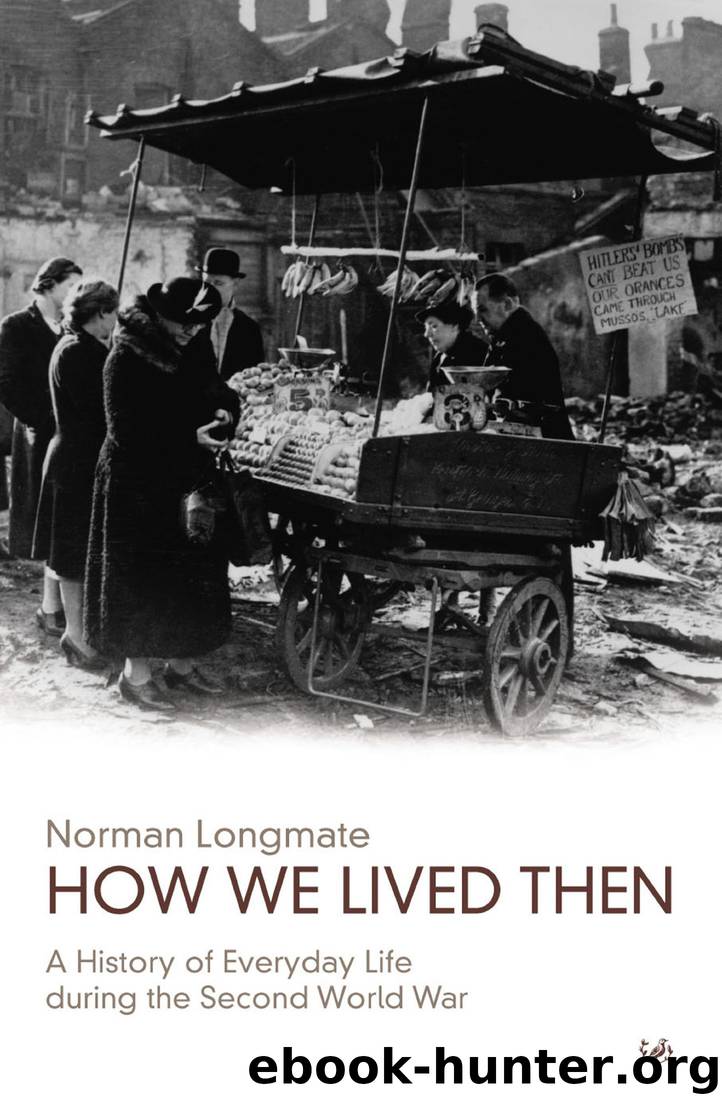
How We Lived Then: History of Everyday Life During the Second World War, A by Norman Longmate
Author:Norman Longmate [Longmate, Norman]
Language: eng
Format: epub
Publisher: Random House
Published: 2010-01-26T00:00:00+00:00
The W.V.S. took selected members on tours of paper-mills, where they saw the disastrous effect that a single paper-clip or rubber band could have on a whole consignment of waste paper, and special arrangements were made for shredding confidential business papers, but more interesting to most salvage workers were the collections of beribboned love letters and private diaries that now came into their hands. A housewife living in the country near Aylesbury who remembers that ‘there was no rush to do the salvage for the village. As we found space for it in an outhouse it became my very own unglamorous job’, found her reward ‘one bitterly cold Sunday afternoon. The remains of somebody’s autograph album arrested my attention. On one page I read “Do your Duty, never mind if it is out in the cold, or by a nice warm fire”. A flattish box revealed some love tokens, love letters; other letters concerned a family quarrel, which should no doubt have been retained after sorting out. Could I ask the suspected owner if she had made a mistake? I kept the box more or less in hiding for some time and eventually “made salvage” of it.’
Early in the war collecting boxes for ‘Books for the Forces’ had appeared in Post Offices and periodically there were attempts to obtain out-of-date books for salvage. The Ministry of Supply looked on private libraries as a large, if scattered, reserve of raw material and in 1943 it decided the time had come to call on it, particularly because by now wartime paper had become frail, rough and yellow after being repeatedly repulped, and good quality, pre-war paper was needed to improve its quality. The Book Drive, it was realised, had its dangers, but most local authorities wisely arranged for every load brought in to be checked by at least a junior library assistant. One librarian still remembers her anxiety that, with time for no more than a glance at the title page, she might have sentenced some valuable item to destruction as she and another girl sat at long trestle tables in the stone-floored decontamination centre in the small town of Dewsbury, near Leeds, sorting each volume into the appropriate pile, while heaps of books piled up remorselessly all-round them. The whole campaign yielded fifty-six million volumes in a few months, of which five million went to the Forces, a million to replace lost stock in bombed libraries and the rest to the mills for repulping. It was the greatest clear-out of bookshelves in British history.
The scrap metal drive had been launched in January 1940 and by July the new Minister of Supply, Herbert Morrison, was already having to assure the public that the material collected had not been forgotten, a statement repeated at frequent intervals, less and less convincingly, for the next five years. By August he was describing the rag-and-bone man as ‘the saviour of the nation’ and was having to restrain Falmouth Council from sending for scrap the guns of the famous Bellerophon, on board which Napoleon had surrendered.
Download
This site does not store any files on its server. We only index and link to content provided by other sites. Please contact the content providers to delete copyright contents if any and email us, we'll remove relevant links or contents immediately.
| Africa | Americas |
| Arctic & Antarctica | Asia |
| Australia & Oceania | Europe |
| Middle East | Russia |
| United States | World |
| Ancient Civilizations | Military |
| Historical Study & Educational Resources |
The Radium Girls by Kate Moore(12033)
100 Deadly Skills by Clint Emerson(4929)
Rise and Kill First by Ronen Bergman(4792)
The Templars by Dan Jones(4690)
The Doomsday Machine by Daniel Ellsberg(4492)
The Rape of Nanking by Iris Chang(4218)
Killing England by Bill O'Reilly(4006)
Stalin by Stephen Kotkin(3971)
Hitler in Los Angeles by Steven J. Ross(3947)
12 Strong by Doug Stanton(3553)
Hitler's Monsters by Eric Kurlander(3344)
Blood and Sand by Alex Von Tunzelmann(3206)
The Code Book by Simon Singh(3194)
Darkest Hour by Anthony McCarten(3134)
The Art of War Visualized by Jessica Hagy(3012)
Hitler's Flying Saucers: A Guide to German Flying Discs of the Second World War by Stevens Henry(2757)
Babylon's Ark by Lawrence Anthony(2684)
The Second World Wars by Victor Davis Hanson(2528)
Tobruk by Peter Fitzsimons(2520)
